From Digital India to AI India, How Technology Is Shaping India's Future
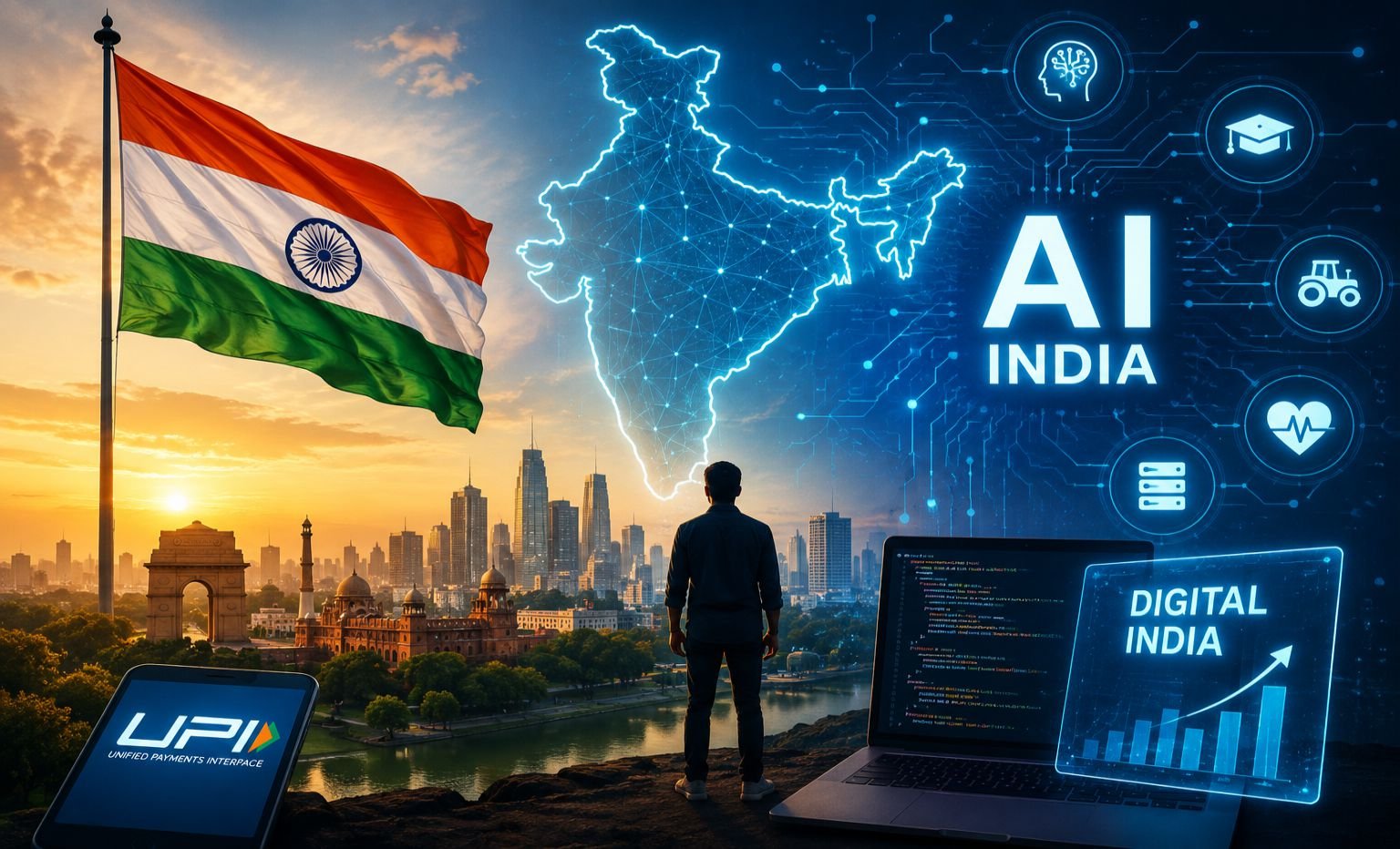
From Digital India to AI India: How Technology Is Shaping India's Future
Every year on 15 August, India celebrates its Independence Day.
It is a day to remember our journey as a nation and the people who helped build modern India.
But the meaning of progress keeps changing with time.
Today, technology is one of the biggest parts of that progress.
The India of today is very different from the India of a few decades ago. We can make payments from a phone, access government services online, study from anywhere, run a business with a small team and connect with people across the world within seconds.
This journey did not happen overnight.
It is the result of years of investment in digital infrastructure, software, internet access, startups, developers and new technology.
Now India is entering another important stage.
The next big chapter is Artificial Intelligence.
From Digital India to AI India, technology is changing not only how we use services, but also how we build businesses, software and solutions for the future.
India's Digital Journey Has Come a Long Way
Digital India was launched in 2015 with the goal of creating a digitally empowered society and knowledge economy.
Since then, digital technology has become part of everyday life for millions of Indians.
Think about some of the things that now feel normal.
You can send money to someone in another city within seconds.
You can store important documents digitally.
You can apply for services online.
Students can learn through online platforms.
Businesses can sell products through websites and apps.
People can communicate with customers, employees and family members from almost anywhere.
These changes may look simple today, but together they represent a major change in how a country works.
The growth of digital public infrastructure has also helped India build technology that can work at a very large scale.
Digital India has now completed more than a decade, and the country is moving from simply becoming more digital to building new technology on top of that digital foundation.
UPI Changed the Way India Thinks About Digital Payments
One of the easiest examples of India's technology journey is digital payment.
For many people, paying through a mobile phone has become a normal part of daily life.
A small shop, a restaurant, a local service provider or a large business can accept digital payments without needing a complicated setup.
This is important because good technology is not only about creating something advanced.
Good technology should solve a real problem and make life easier.
That is one reason India's digital infrastructure has received attention around the world.
The same idea can be applied to Artificial Intelligence.
AI should not only be about impressive demos.
It should solve real problems for real people.
The Next Chapter: Artificial Intelligence
Artificial Intelligence is becoming one of the most important technologies in the world.
AI can help software understand text, generate content, analyse information, work with images, process audio and assist people with many different tasks.
But the bigger opportunity is not simply using AI tools.
The bigger opportunity is building useful products with AI.
For India, this can mean applications for:
- Healthcare
- Education
- Agriculture
- Banking and finance
- Customer support
- Government services
- Business automation
- Cybersecurity
- Software development
- Research and data analysis
India has already started building a larger AI ecosystem through the IndiaAI Mission.
The mission was approved in 2024 with an outlay of ₹10,371.92 crore and focuses on areas such as computing infrastructure, AI innovation, datasets, skills, startups and responsible AI.
Why AI Matters for Indian Businesses
AI is not only for large technology companies.
Small and medium businesses can also use AI.
Imagine a business that receives hundreds of customer questions every day.
An AI system can help answer common questions.
A company that receives thousands of documents can use AI to extract useful information.
A sales team can use AI to organise leads and understand customer messages.
A software company can add an AI assistant to its application.
A school can use AI-based tools to help students learn.
A hospital can use software to organise information and support medical workflows.
The technology will be different for every business.
That is why the future will not simply be about using one AI tool.
It will be about building the right AI solution for a particular problem.
India's AI Opportunity Is Bigger Than Chatbots
When people hear the word AI, many immediately think about chatbots.
Chatbots are useful, but AI is much bigger than that.
Modern AI applications can work with documents, images, audio, data and software systems.
Developers can build AI applications that connect with databases, APIs and business software.
For example, a company could build an AI system that reads invoices, checks information, stores the data in a database and sends the result to an internal dashboard.
Another company could build an AI assistant that searches thousands of documents and gives employees useful answers.
These are not science-fiction ideas.
They are software engineering problems that can be solved by combining AI with existing technologies.
The Role of Indian Developers
This is where the opportunity becomes especially interesting for developers.
India already has a large software development community.
Millions of developers work with technologies such as PHP, Laravel, React, JavaScript, Python, Node.js, MySQL and cloud platforms.
AI does not remove the need for these technologies.
In many cases, AI makes them more useful.
An AI model still needs an application around it.
That application needs authentication.
It needs a database.
It may need APIs.
It may need a dashboard.
It may need payments.
It may need queues, notifications, file storage and security.
This means traditional software development and AI development are increasingly coming together.
Laravel and AI: A Practical Combination
For PHP and Laravel developers, this creates an interesting opportunity.
Laravel can be used to build the application layer around AI.
For example, a Laravel application can handle:
- User authentication
- Database operations
- API requests
- File uploads
- Queues
- Notifications
- Payments
- Admin dashboards
- Business logic
AI services can then be connected to that application to provide intelligent features.
This can be used to build AI chatbots, document assistants, AI-powered search, recommendation systems, content tools and business automation platforms.
The important point is that AI is not replacing software development.
It is becoming another powerful part of software development.
React and AI Applications
The frontend also plays an important role.
React can be used to create modern interfaces for AI applications.
For example, an AI application may need:
- Chat interfaces
- Streaming responses
- File upload screens
- Analytics dashboards
- AI-generated content editors
- Search interfaces
- Admin panels
React can handle the user interface while a backend such as Laravel handles business logic, authentication and data.
Together, these technologies can be used to build complete AI-powered products.
India's AI Future Will Need More Than Technology
Technology alone is not enough.
AI also creates important questions about privacy, security, accuracy and responsible use.
An AI system can produce useful results, but it can also make mistakes.
Businesses need to understand what data they are sending to AI systems.
Developers need to think about authentication and access control.
Companies need to protect customer information.
AI-generated answers should not automatically be treated as facts.
Responsible development will become just as important as fast development.
India's AI ecosystem is also focusing on safe and trusted AI. The IndiaAI Mission includes a Safe & Trusted AI pillar aimed at responsible AI development and deployment.
What India's AI Future Could Look Like
The most interesting part of India's technology journey is that we are still early in the AI era.
The next few years could bring AI into many areas that currently depend on manual work.
We may see more AI-powered:
- Business applications
- Education platforms
- Healthcare systems
- Financial tools
- Government services
- Customer support systems
- Developer tools
- Cybersecurity solutions
- Local-language applications
- Small business software
India also has a major opportunity in building technology for its own large and diverse population.
Applications that understand different Indian languages, local business needs and real-world challenges can have a huge impact.
The India AI Impact Summit 2026 also placed strong focus on using AI for real-world problems and inclusive outcomes, showing how India's AI conversation is moving beyond research and experiments toward practical applications.
What Should Indian Developers Learn?
If you are a developer, this is a good time to expand your skills.
You do not need to become an AI researcher overnight.
Start with the basics.
Learn how AI APIs work.
Understand prompts and structured outputs.
Learn how to connect AI with a backend.
Understand embeddings and vector search.
Learn about RAG.
Explore AI agents.
Understand how to secure AI applications.
And most importantly, learn how to build real projects.
A developer who understands both software engineering and AI can solve a wider range of problems.
What Should Businesses Do?
Businesses should not add AI just because everyone is talking about it.
The first question should always be:
What problem are we trying to solve?
If a task is repetitive, takes a lot of time or requires processing large amounts of information, AI may be useful.
Start with a small problem.
Build a simple solution.
Measure the result.
Then improve it.
This approach is usually better than trying to add AI to every part of a business at once.
From Digital India to AI India
India's technology story is still being written.
Digital India helped create a strong digital foundation.
Now AI can build on top of that foundation.
The next stage will not only be about consuming technology created somewhere else.
It will also be about Indian developers, startups and companies building useful technology for India and the rest of the world.
That is where the real opportunity lies.
On this Independence Day, we can look at India's progress not only through roads, buildings and industries, but also through the technology we create, the problems we solve and the ideas we take to the world.
The journey from Digital India to AI India is already underway.
And the most exciting part is that there is still a lot left to build.
Final Thoughts
Technology changes quickly.
The tools we use today may look very different a few years from now.
But one thing will remain important: people who can understand problems and build useful solutions will always have opportunities.
For developers, businesses and technology companies, India's next chapter is going to be an interesting one.
The future of technology in India is not only about AI.
It is about what we choose to build with it.
Happy Independence Day, India.
Jai Hind.
Discussion Thread
Shree ram
1 month agoVery nice knowledge well done